Martinique is a French and European territory: a foreign buyer purchases there under French law, in euros, before a notary. This guide explains how to invest in Martinique without living there, from buying the land to following the build, including financing, remote signing and the taxation of non-residents. Your personal situation still needs to be confirmed with a notary and a tax advisor.
Architect’s view
Contents
Key takeaways
French territory and an outermost region of the European Union: French law and the euro apply there.
No law prohibits, as a general rule, the sale of real estate to a foreign national.
Since 2020, a notarized power of attorney can be signed remotely, by secure video conference.
Rental income is taxable in France; for income from the French overseas departments (DOM), the minimum rate for non-residents is 14.4% or 20%.
Before buying: buildability, the Coastal Law (loi Littoral), the “fifty geometric paces” coastal strip (cinquante pas géométriques) and property title.
Investing in Martinique: a French and European territory
Since January 1, 2016, Martinique has been governed by a single territorial authority, the Territorial Collectivity of Martinique (Collectivité territoriale de Martinique). Created by Law No. 2011-884 of July 27, 2011, it exercises the powers of an overseas department and of an overseas region. The French Constitution sets out the principle: in the overseas departments and regions, laws and regulations apply automatically, subject to adaptations.
For the European Union, Martinique is one of the nine outermost regions. It is an integral part of the Union, whose law applies on its territory, with adaptations provided for by Article 349 of the Treaty on the Functioning of the European Union.
In practice, you buy in euros, under French law, through the French banking and notarial system. The law governing the purchase is that of the place where the property is located. The rules for real estate sales are therefore those of mainland France; a few provisions specific to overseas France exist, such as the “fifty geometric paces” coastal strip (zone des cinquante pas géométriques).
Can a foreign buyer purchase property?
Yes. In response to a question in the Sénat, the French Ministry of Justice reiterated in August 2025 that no statutory provision prohibits, as a general rule, the sale of real property to a person of foreign nationality. The French Civil Code (Code civil) sets out the principle: anyone may buy unless prohibited by law. The notary will review your nationality, your country of residence and your marital property regime (régime matrimonial) to prepare the deed.
Architect’s view
The role of the notary
In France, the sale of real estate is signed before a notary. Before the signing, the notary checks the property’s legal status and the seller’s ownership rights. After the signing, the notary has the deed recorded with the land registry (service de la publicité foncière): this formality makes the sale enforceable against third parties.
The notary also has a duty to advise on the taxation that will apply depending on how the property is used. Finally, the notary must verify the source of the funds, as part of the fight against money laundering. Prepare the documents proving the origin of your down payment from the outset.
Buying land or joining a program
There are two possible routes. Buying land lets you choose the location, but requires you to check that it is buildable before you commit. Joining an existing program brings you into a development whose land and design are already defined. In both cases, have the type of contract, the payment schedule and the applicable guarantees specified in writing.
To help you estimate the budget, our guide to the cost of building a villa in Martinique details the cost items. Check whether the prices quoted exclude tax (hors taxes): in Martinique, the standard VAT rate is 8.5%.
Architect’s viewArchitect’s view
Financing the purchase from abroad
Two main options are open to you: a loan from a French bank or financing in your country of residence. Each bank sets its own conditions for a non-resident borrower: amount of the down payment, guarantees, borrower insurance, proof of income. Compare offers before signing the preliminary sale agreement (avant-contrat).
If your income is earned in a currency other than the euro, repaying a loan in euros exposes you to exchange rate risk. Whatever the arrangement, you must be able to document every transfer of funds, from your account through to the signing.
Architect’s view
Signing remotely: power of attorney and electronic deed
You do not have to travel to sign. If you cannot be present, you can give power of attorney to someone who will sign on your behalf; this representation is stated in the deed. The notary will tell you which form of power of attorney is required.
Since Decree No. 2020-1422 of November 20, 2020, the notary can draw up a notarized power of attorney (procuration authentique) remotely. Your documents and identity are first verified on a secure platform. The power of attorney is then signed by video conference, using the system provided by the notary and approved by the profession: consumer apps are excluded. The deed of sale itself can be drawn up in electronic form.
Plan ahead: arrange the power of attorney with the notary several weeks before the signing date. Have a computer with a webcam and microphone, a stable connection and a copy of your ID ready.
Architect’s view
Non-resident taxation: the principles
Rental income from a villa rented out furnished in Martinique is taxable in France, under the category of industrial and commercial profits (bénéfices industriels et commerciaux, BIC). As a non-resident, you declare your French-source income every year.
The tax follows the progressive income tax scale, with a minimum rate specific to non-residents. For income from the French overseas departments, this minimum rate is 14.4% up to €29,579 of net taxable income, then 20% above that amount (threshold for 2025 income), compared with 20% and 30% for other French-source income. If your average rate, calculated on your worldwide income, is lower, you can request that it be applied.
Social contributions (prélèvements sociaux) are added on top, at an overall rate of 18.6% in 2026 for non-professional furnished rentals (LMNP). If you are covered by the social security system of a country in the European Economic Area, Switzerland or the United Kingdom, only the 7.5% solidarity levy (prélèvement de solidarité) is due.
The role of tax treaties
France has signed tax treaties with many countries, including the United States, Canada, China, Saudi Arabia, the United Arab Emirates and Qatar. They allocate taxing rights between the two countries and provide for the elimination of double taxation. Your final tax liability depends on the treaty concluded with your country of residence and on how that country treats income already taxed in France. Have a tax advisor review your situation before you buy.
Landlord status and ownership structure
Most investors fall under the non-professional furnished rental status (LMNP). You become a professional landlord (loueur professionnel) if your rental receipts exceed €23,000 per year and are greater than your other earned income. For a non-resident, the 2026 Finance Act (loi de finances pour 2026) includes in this comparison the earned income taxed in their country of residence, starting with 2026 income.
Holding the villa through a company is not a neutral choice: according to the French tax authorities, a non-trading real estate company (société civile immobilière) that regularly rents out furnished property becomes liable for corporate income tax (impôt sur les sociétés). The micro-BIC and actual-expense (réel) tax regimes are explained in our guide to villa vacation rentals in Martinique.
IFI and resale
A non-resident is liable for the French real estate wealth tax (IFI) only on real estate located in France, above €1.3 million of net taxable assets; loans related to the property are deductible. On resale, the capital gain is taxed at 19%, plus 17.2% in social contributions (only 7.5% for a person covered by the social security system of another European Economic Area country, Switzerland or the United Kingdom), with allowances based on how long the property has been held: exemption from income tax after 22 years, and from social contributions after 30 years. Above €50,000 of taxable gain, a surtax of 2% to 6% applies. A seller who resides outside the European Economic Area generally appoints an accredited tax representative for a sale above €150,000.
Architect’s viewArchitect’s view
A turnkey project monitored remotely, in six steps
VillaDesign Caraïbes designs, builds, equips, rents out and maintains turnkey villas, with a single point of contact from the land to the first guest. The process follows six steps:
Land selection and feasibility: land to be acquired or joining an existing program, technical study.
Legal structuring, with a partner notary and tax advisor.
Tax analysis: non-professional furnished rental status (LMNP) and the tax treaty with your country of residence.
Turnkey construction: bioclimatic architecture, furniture, bathroom fixtures, pergola and solar power.
Rental launch as soon as the keys are handed over.
Remote reporting: occupancy, income and condition of the villa.
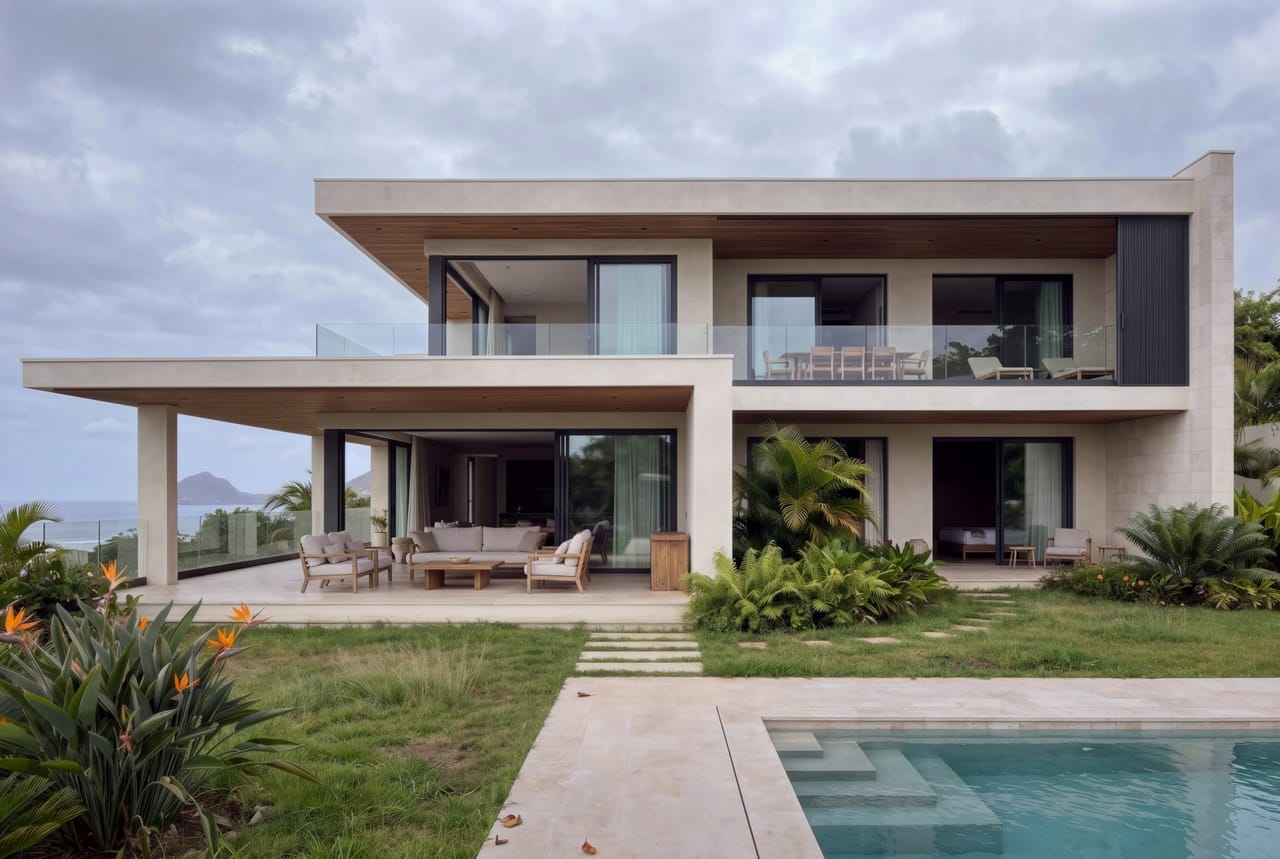
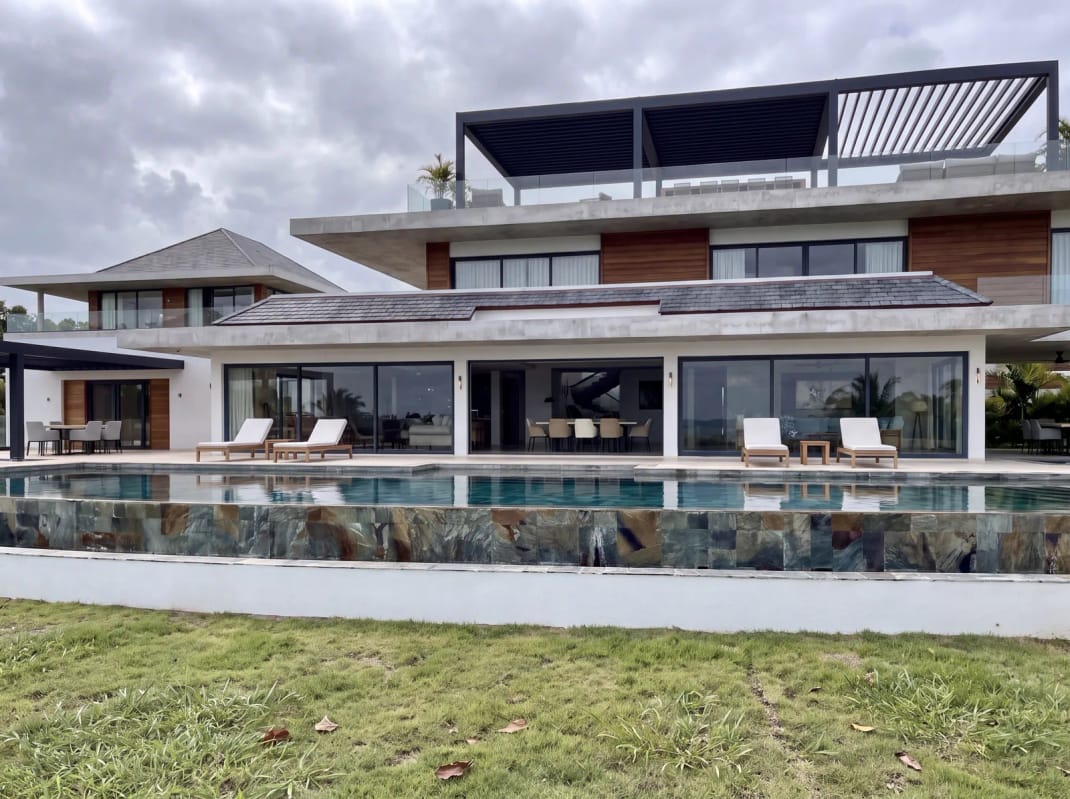
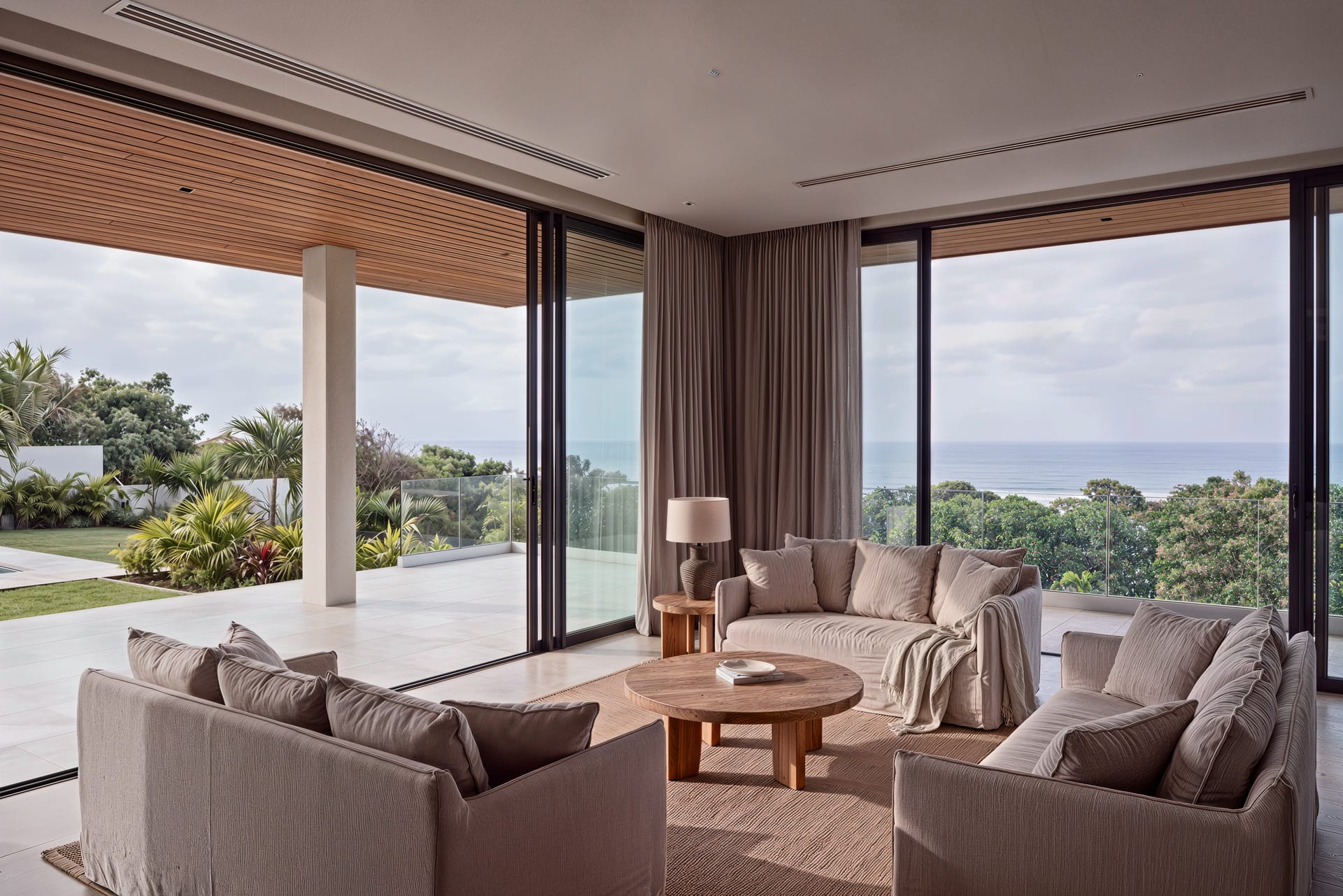
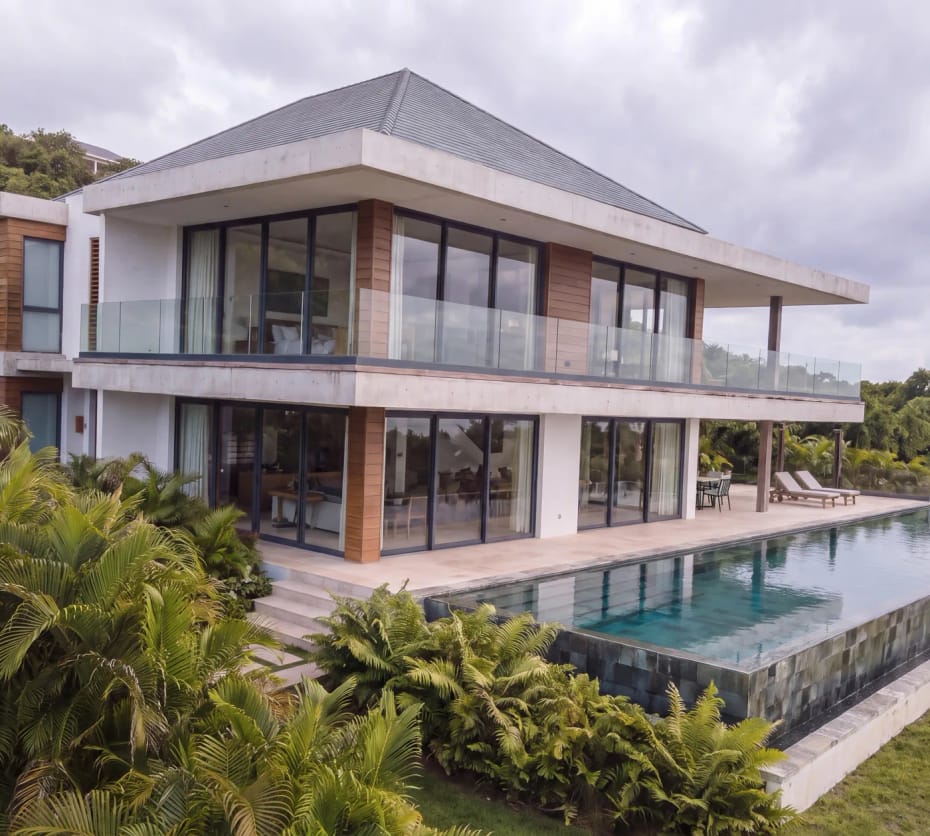
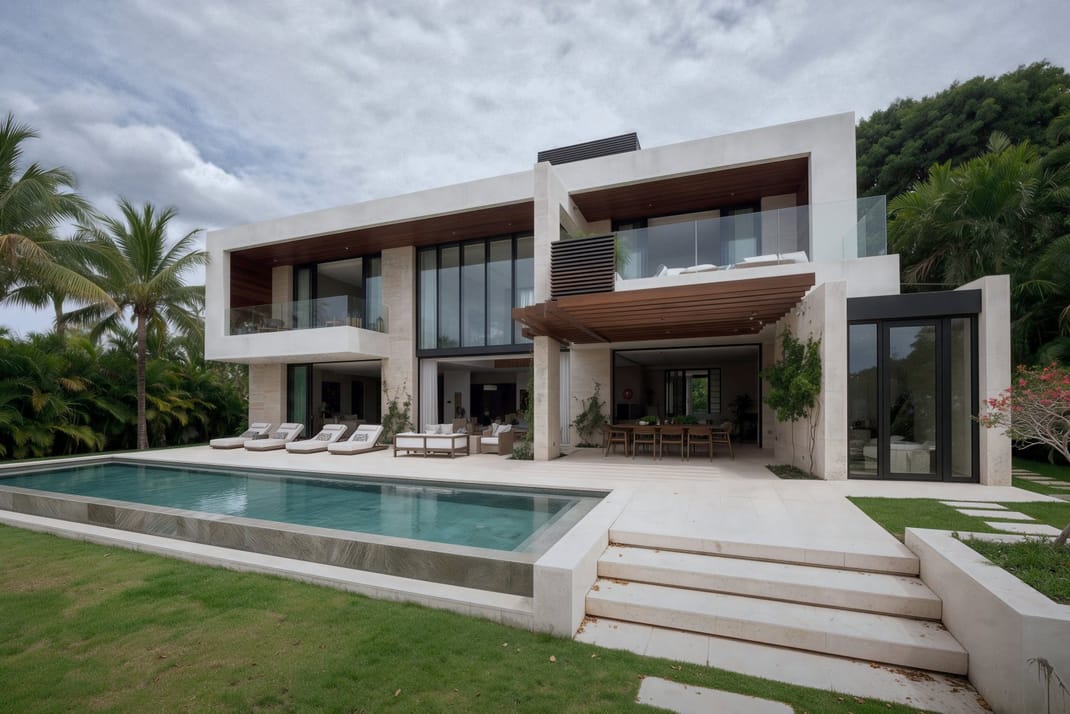
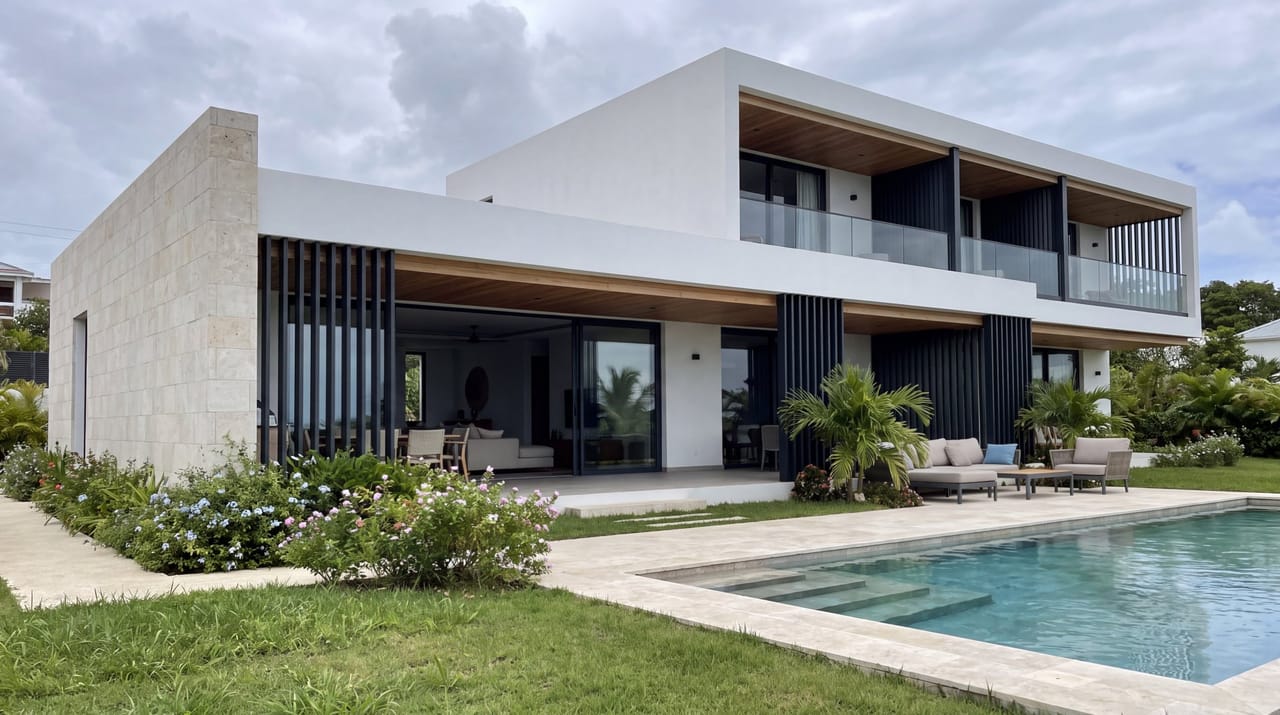
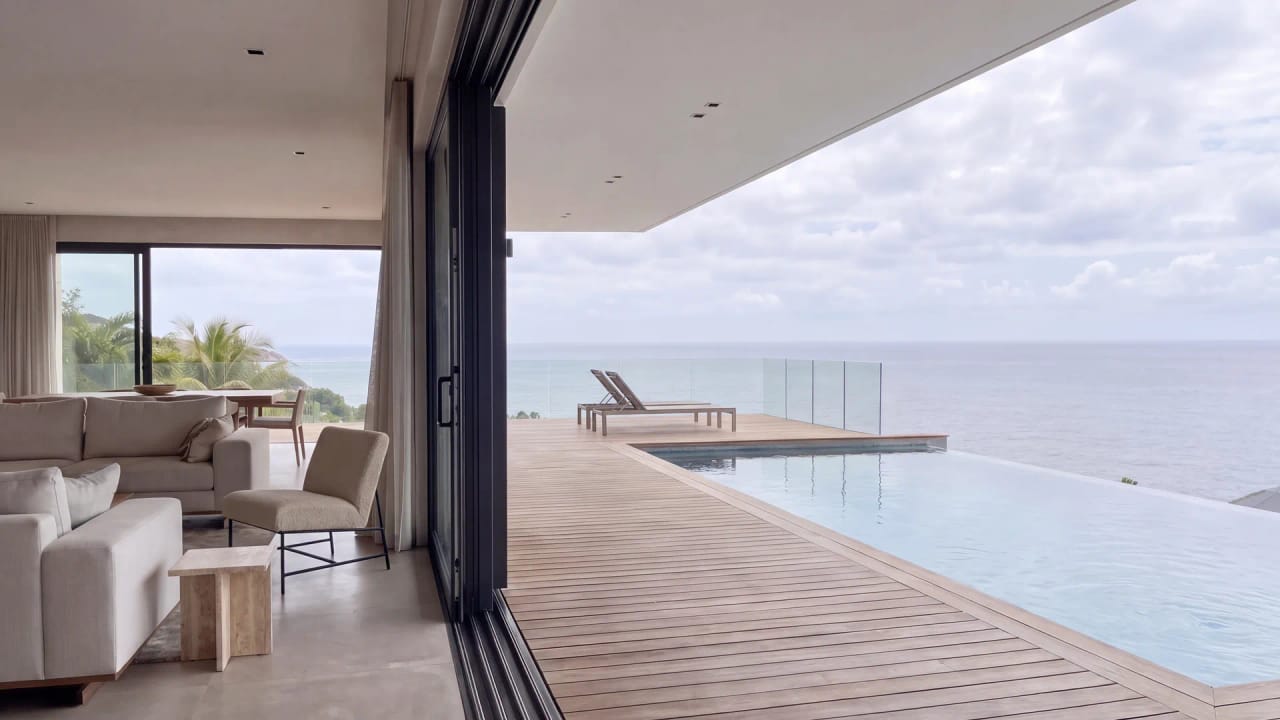
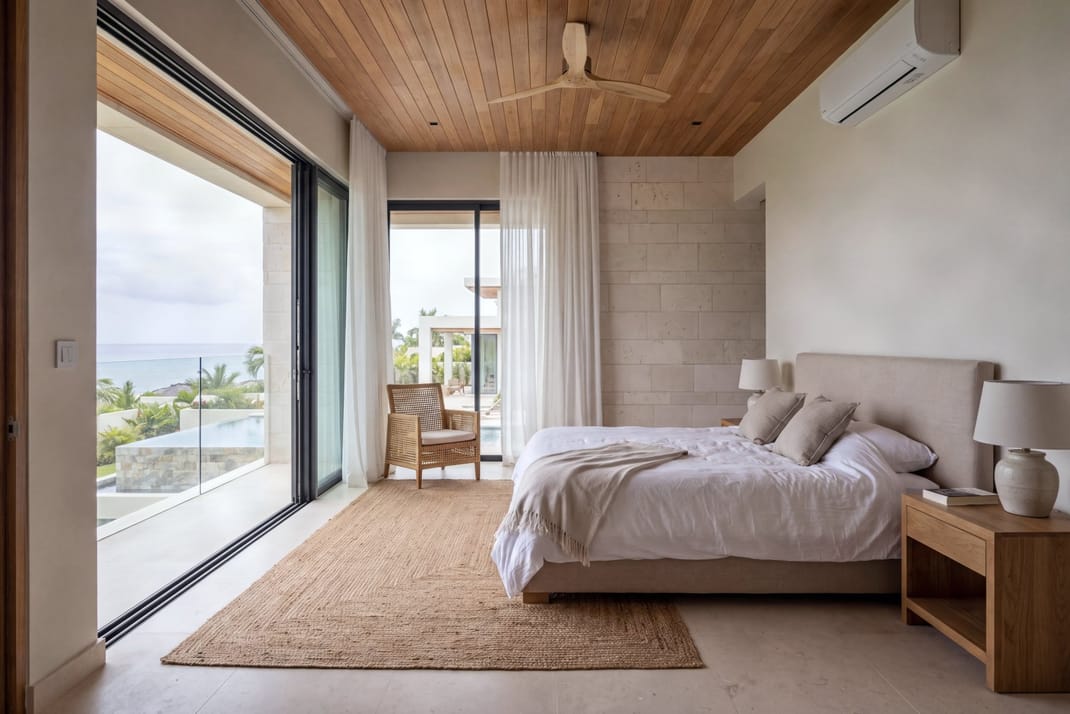
During construction, dated photos are published as the work progresses. No rendering is presented as a photo: the visuals of upcoming villas are architect’s views. The current program comprises seven villas for an international investor, four under construction and three at the permit stage; their progress can be seen in Our work.
Getting there
Martinique Aimé Césaire International Airport handled 1.9 million passengers in 2025, according to INSEE. Its direct destinations include Paris, Bordeaux, Miami, Montreal, Toronto, Quebec City and several Caribbean islands. The list published by the airport includes no direct flights to Asia or the Middle East: plan for a connection. Check airline schedules before planning a visit.
Architect’s view
Points to watch before you commit
Buildability: request a project-specific zoning certificate (certificat d’urbanisme opérationnel). It states whether your project is feasible on the plot and remains valid for 18 months. By the sea, also check how the Coastal Law (loi Littoral) applies.
The “fifty geometric paces” strip (cinquante pas géométriques): in the French overseas departments, a band 81.20 meters wide measured from the shoreline, in the absence of an explicit boundary, extends the public maritime domain (domaine public maritime). Land located in this zone is subject to specific rules.
Property title: a law of December 27, 2018, created an exceptional legal regime for overseas France to make it easier to end joint ownership among heirs (indivision successorale), applicable until December 31, 2028. Have the notary verify that all rights are consolidated and that the seller is entitled to sell.
Seismic and hurricane risk: Martinique is classified as seismic zone 5, the highest level. Construction must comply with Eurocode 8 or, for a house, the simplified earthquake-resistant construction rules for zone 5; see our guide to seismic and hurricane-resistant building rules in the French Caribbean.
Builder’s insurance: the ten-year builder’s liability insurance (garantie décennale) must be taken out before work begins, and its certificate must be given to you before the construction site opens.
Inheritance: the law that will apply to your estate depends, in particular, on your habitual residence and on the treaties between France and your country. Have the notary review this at the time of purchase.
Do you live outside France and want to explore a project? Tell us your country of residence and your investment timeframe from the Invest page. We will get back to you with an initial assessment, with no obligation.
This guide provides general guidance, checked as of the update date. It does not replace the advice of a notary, a lawyer or a tax advisor on your situation.
FAQ
Frequently asked questions
Short answers to the questions we are asked most often on this topic.
Can a foreign national buy a villa in Martinique?
Yes. No statutory provision prohibits, as a general rule, the sale of real estate to a person of foreign nationality, as the French Ministry of Justice reiterated in 2025. The purchase is made under French law, in euros, before a notary. The notary reviews your nationality, your country of residence and your marital property regime (régime matrimonial) to prepare the deed.
Do I need to come to Martinique to sign at the notary’s office?
No. You can give power of attorney to someone who will sign on your behalf. Since the decree of November 20, 2020, the notary can draw up this power of attorney remotely, by secure video conference. The notary will tell you the exact form required.
Will my rental income be taxed in France or in my country of residence?
Rental income from a villa rented out furnished in Martinique is taxable in France. Your country of residence may also take it into account: the tax treaty concluded between the two countries provides for the elimination of double taxation. Have a tax advisor review your situation before investing.
What is the minimum tax rate for a non-resident?
For income from the French overseas departments, the minimum rate is 14.4% up to €29,579 of net taxable income, then 20% above that amount (threshold for 2025 income). If your average rate calculated on your worldwide income is lower, you can request that it be applied. Social contributions (prélèvements sociaux) are added to the tax.
Can I borrow from a French bank as a non-resident?
Each bank sets its own conditions for a non-resident borrower: down payment, guarantees, borrower insurance, proof of income. If your income is earned in a currency other than the euro, a loan in euros exposes you to exchange rate risk. Compare with financing in your country of residence before committing.
Can I follow the construction without traveling?
Yes. Dated construction photos are published as the work progresses, and then remote reporting on occupancy, income and the villa’s condition takes over. A single point of contact coordinates the steps, from the land to the rental launch.