Villa vacation rentals in Martinique: returns, management and taxation
Vacation rental (short-term rental) lets a villa in Martinique earn income while you are away. You still need to understand tourist demand, the host’s obligations, the taxation of furnished rentals, and the true cost of management. This guide reviews the rules in force in 2026 and offers a profitability simulation, presented as a working hypothesis.
Architect’s view
Contents
Key takeaways
571,511 stay-over tourists in 2024, their highest level in 40 years (INSEE).
Micro-BIC 2026: €83,600 revenue ceiling and 50% deduction if the furnished rental is star-rated (classé), €15,000 and 30% otherwise.
National online registration service announced for the fourth quarter of 2026; registration number required on every listing.
Actual-expense regime (régime réel): depreciation added back when calculating the capital gain on sales made since February 15, 2025.
In our hypothetical simulation, going from 30% to 60% occupancy more than triples net income.
Vacation rentals in Martinique: tourist demand
According to INSEE, drawing on data from the Martinique Tourism Authority (Comité martiniquais du tourisme), Martinique received 988,301 visitors in 2024, including 571,511 stay-over tourists, up 2.8%. This is the highest level of stay-over tourism in 40 years.
These tourists come mainly from mainland France (65%), followed by the Caribbean (22%), Canada (6%), the rest of Europe (5%), and the United States (2%). Their stay lasts 11 days on average. More than four in ten (44%) stay in rented accommodation: a villa, an apartment, a tourist residence, or a gîte (holiday cottage).
In 2025, traffic at Aimé Césaire Airport rose 2.3% to 1.9 million passengers, while hotel stays fell 6.4%. In INSEE’s view, this gap suggests “greater use of alternatives to hotels.”
High and low season
The calendar follows the climate. The high tourist season runs from December to April: it coincides with the carême, the dry season, whose core runs from February to April according to Météo-France. The hivernage, the hotter and rainier season (at its height from July to October), falls within the Atlantic hurricane season, from June 1 to November 30, with a heightened risk in August and September. Demand is concentrated in the first part of the year: in 2024, the first half accounted for 61% of annual tourist visits.
Rates are therefore set by season, then adjusted to observed demand. The quieter months are used to schedule maintenance and work on the property.
Architect’s view
What gets a villa booked
Location: access, distance to beaches and shops, exposure. According to Météo-France, the Caribbean coast, on the leeward side, is drier and a little sunnier than the north and the Atlantic coast, which are exposed to the wind.
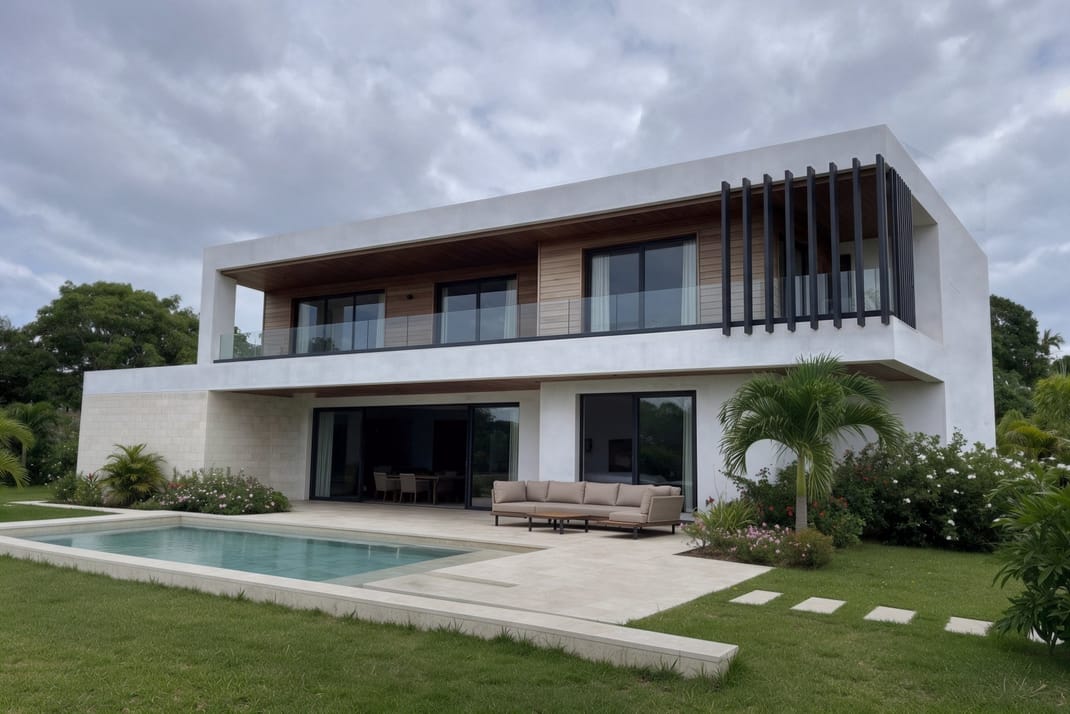
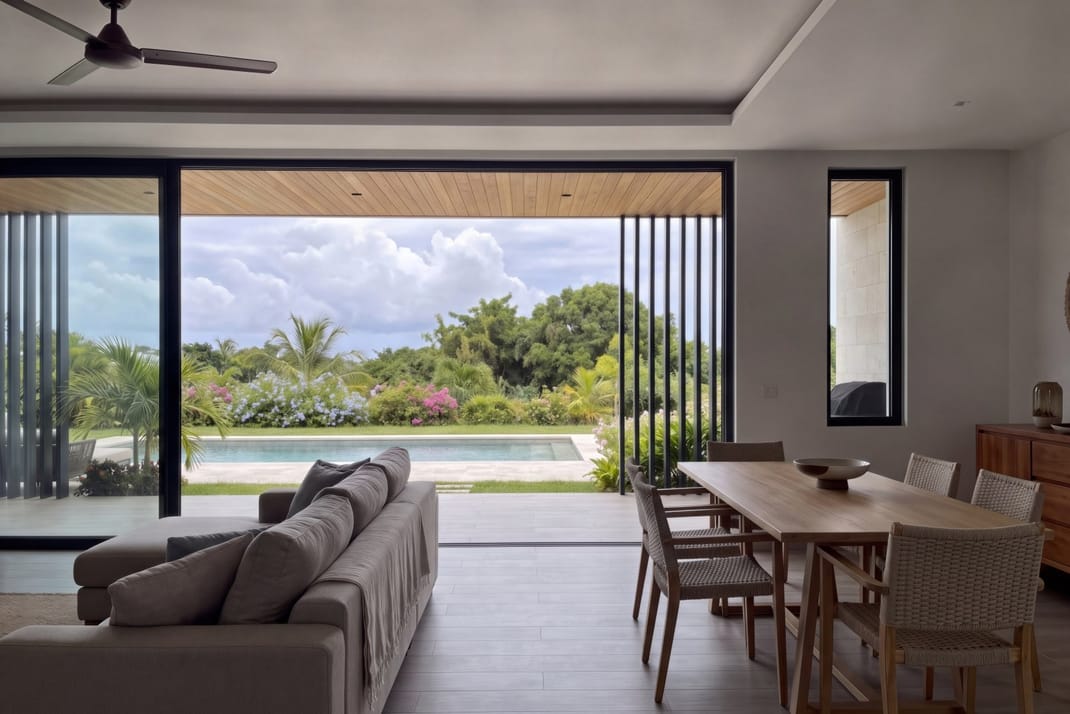
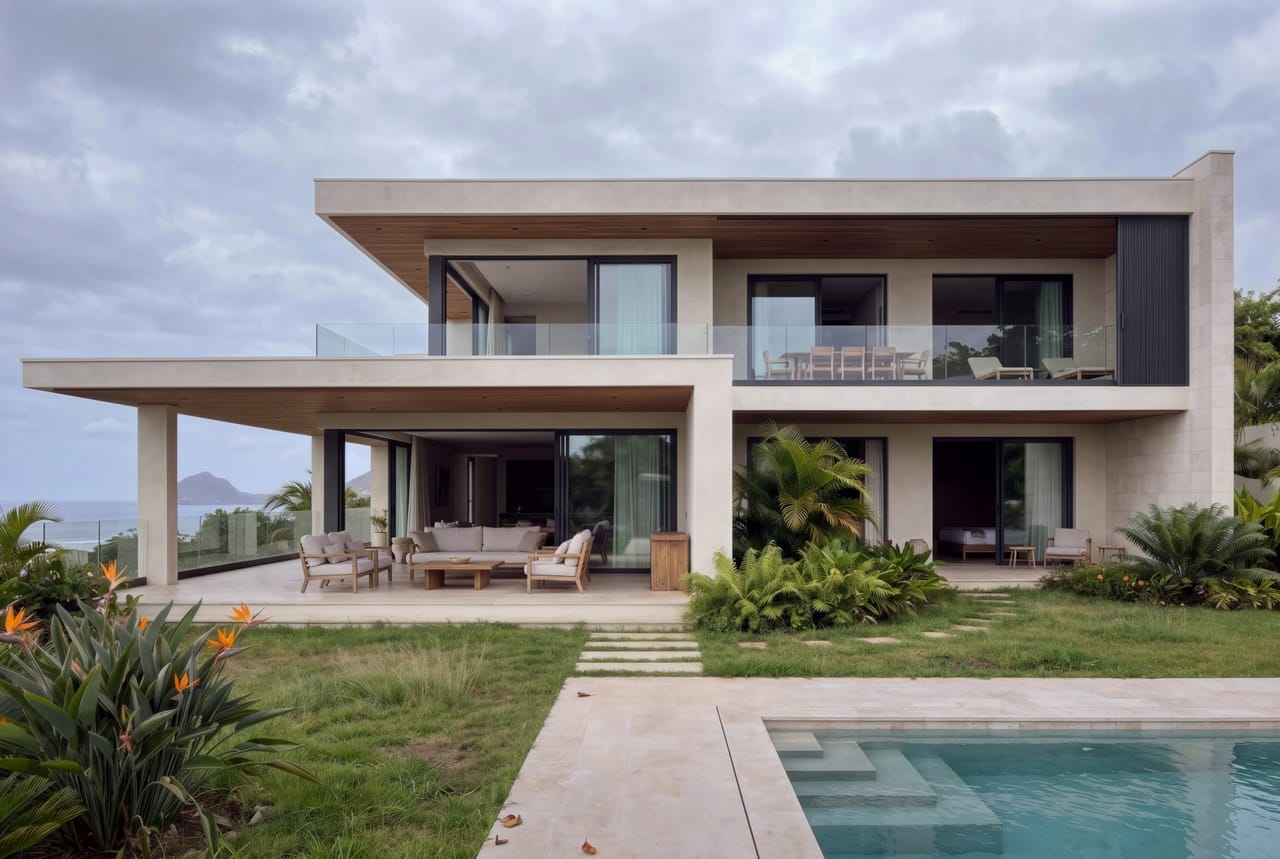
The view and outdoor spaces: a shaded terrace, privacy, living areas that open onto the landscape.
The pool and amenities, maintained and in working order for every arrival.
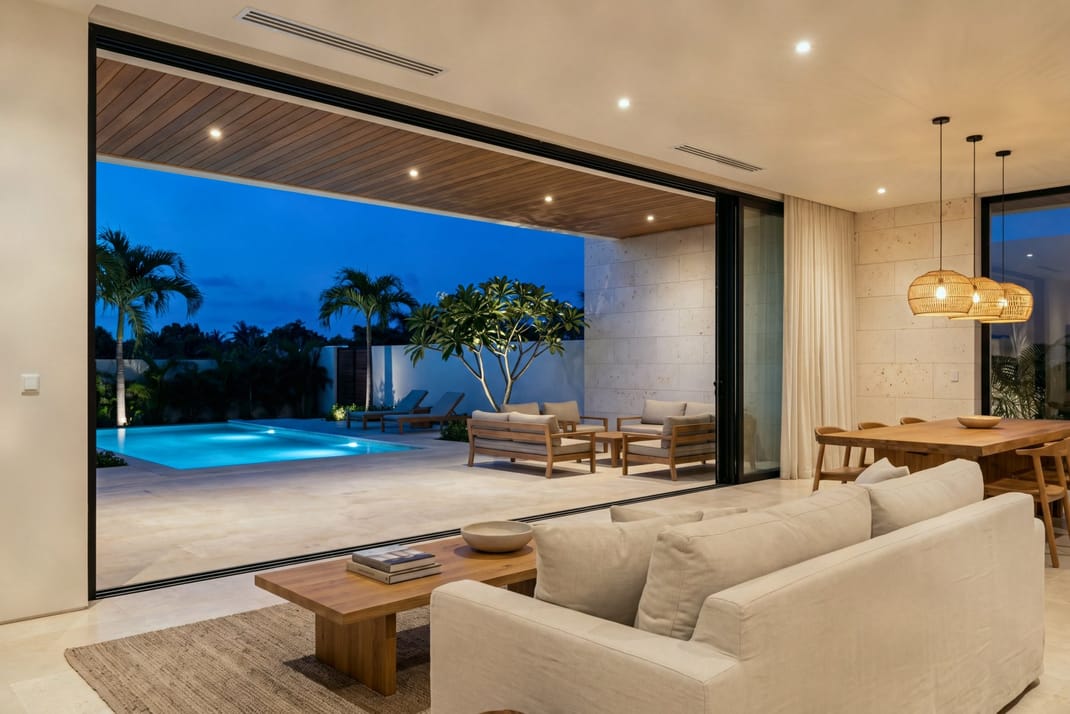
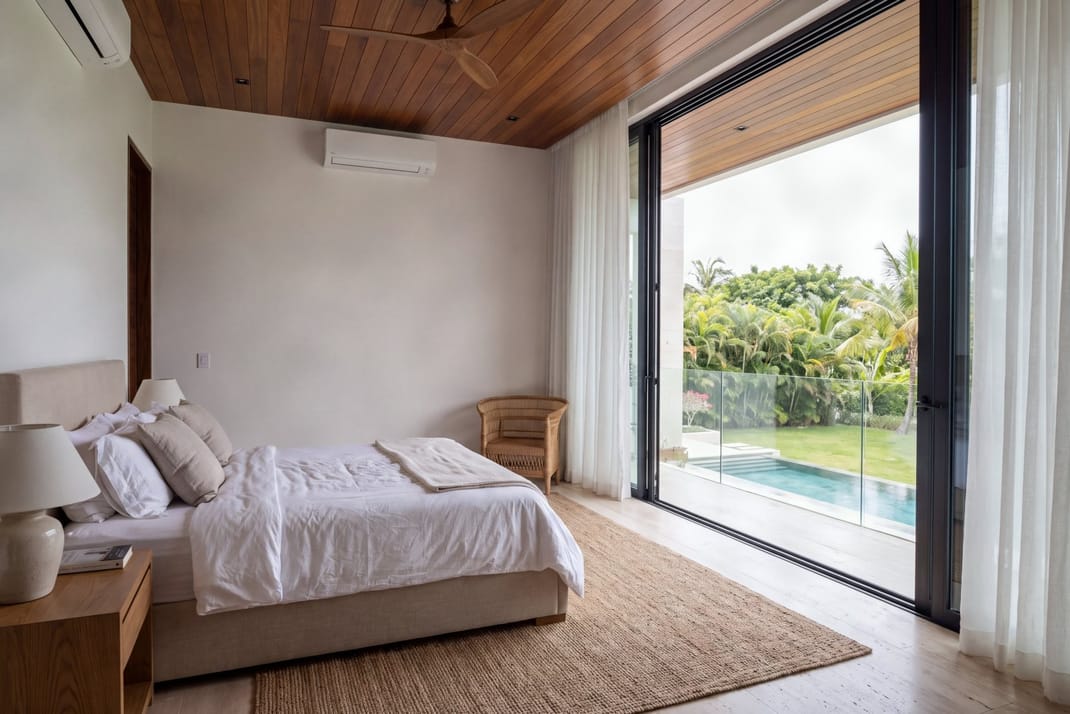
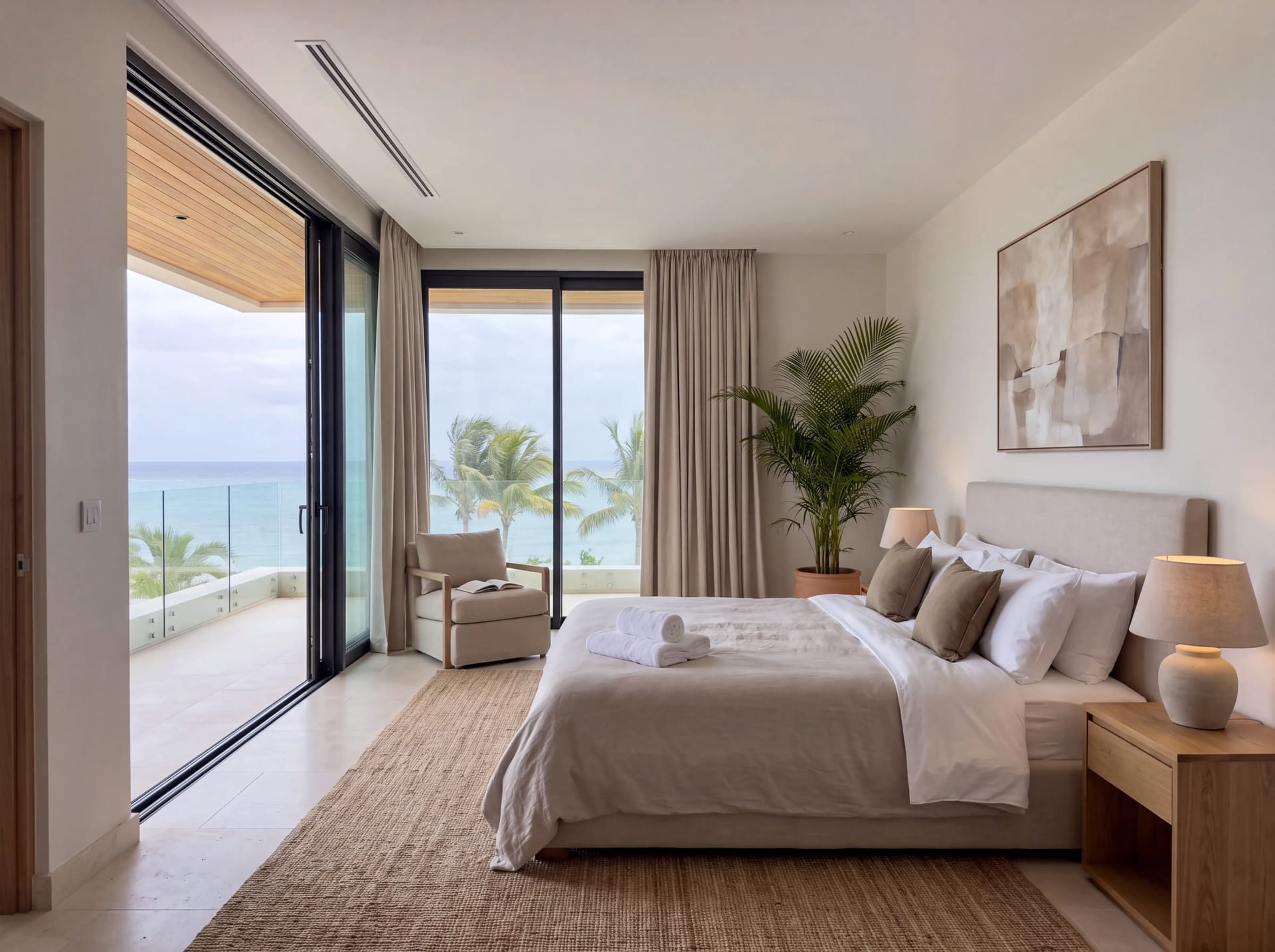
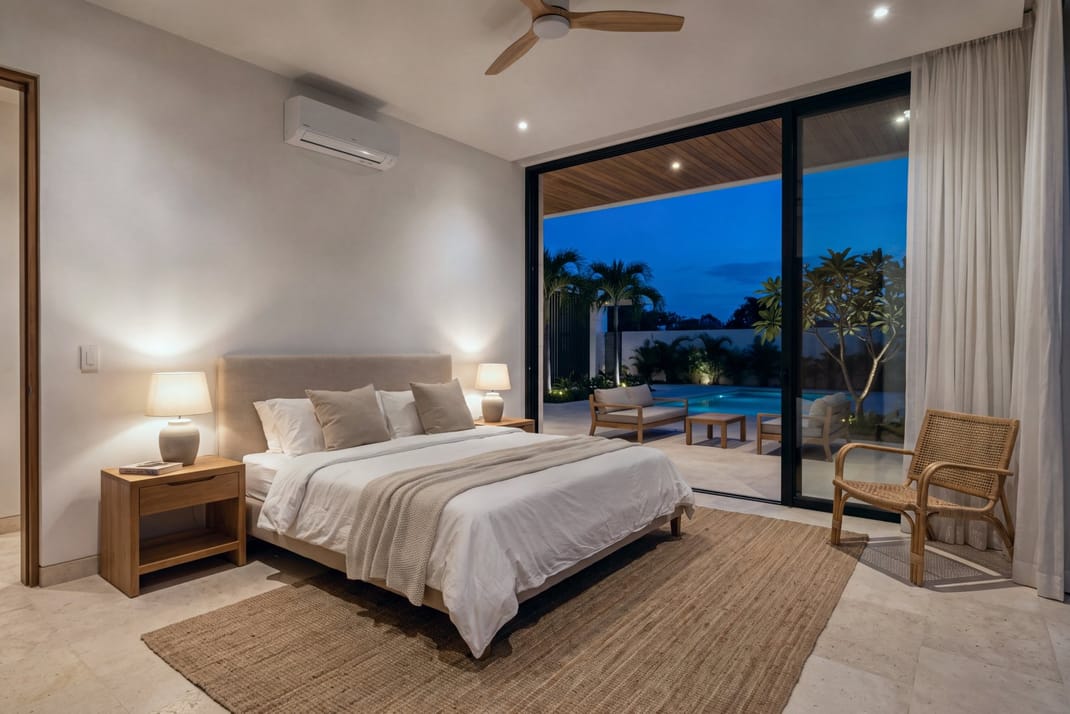
Thermal comfort: natural ventilation, sun protection, and air-conditioned bedrooms. A bioclimatic design reduces the need for air conditioning, and therefore running costs.
Equipment: bedding, kitchen, linens, internet connection, furniture suited to the climate. Our interior design page presents this part of the project.
Honest photos: the listing must show the villa as it is. Any gap between the photos and reality exposes you to complaints and poor reviews.
Architect’s viewArchitect’s view
The host’s obligations in 2026
Declaration and registration number
Law No. 2024-1039 of November 19, 2024, known as the Le Meur Law (loi Le Meur), replaces the declaration at the town hall (déclaration en mairie) with a declaration registered through a national online service, which issues a number that must appear on every listing. The law provides for entry into force on a date set by decree, no later than May 20, 2026. According to Service-Public (July 2026), the online service is due to open in the fourth quarter of 2026: registration will then become mandatory in all municipalities, and numbers already issued by a municipality will have to be renewed.
Until then, the town hall of the municipality where the villa is located will tell you the procedure to follow. The law also provides for a fine of up to €20,000 for a false declaration or the use of a false number.
Tourist tax (taxe de séjour)
The tourist tax is established by the municipality or the intermunicipal authority, which sets its rate. When it is levied on a per-guest basis (“au réel”), it is paid by the guest and collected by the host or by the booking platform. For a furnished rental rated 5 stars (meublé classé), the 2026 rate is between €0.70 and €3.60 per person per night, depending on the local council’s decision. For an unrated furnished rental, it is 1% to 5% of the per-person cost of the night, up to a ceiling.
Star rating as a furnished tourist rental (meublé de tourisme)
The rating, from 1 to 5 stars, is optional. You request it from the inspection body of your choice. After its visit, the body sends you, within one month, a certificate with a proposed rating. Unless you refuse it within fifteen days, the rating is granted for five years. It changes the tax treatment, as the next section shows.
Architect’s view
Taxation of furnished rentals: micro-BIC or actual-expense regime (régime réel)
Rental income from a furnished property falls under the industrial and commercial profits category (bénéfices industriels et commerciaux, BIC). You have non-professional furnished rental status (LMNP) if the receipts of your tax household (foyer fiscal) are below €23,000 per year, or if they remain below your other earned income. The activity must be declared on the one-stop portal for business formalities (guichet unique) within fifteen days of the start of the rental, in order to obtain a SIRET number.
The micro-BIC tax regime
Furnished tourist rental
Revenue ceiling, 2025 income
Revenue ceiling, 2026 income
Flat-rate deduction
Star-rated
€77,700
€83,600
50%
Unrated
€15,000
€15,000
30%
The 50% and 30% deductions introduced by the Le Meur Law apply from 2025 income onward. The deduction stands in for expenses: no actual expenses are deducted. The ceilings are assessed across all your furnished rentals. The micro-BIC regime continues to apply if the ceiling is exceeded in only one year; the actual-expense regime (régime réel) becomes mandatory after two consecutive years above the ceiling.
The actual-expense regime (régime réel)
Under the actual-expense regime, you deduct your actual expenses (management fees, insurance, loan interest, repairs) and you depreciate the cost of the property (excluding land) and the furniture. A loss from non-professional furnished rental can only be offset against income of the same kind, for ten years.
Be careful when reselling: for sales made since February 15, 2025, the depreciation deducted is subtracted from the acquisition price when calculating the capital gain, regardless of when the property was first rented out. The gross capital gain increases by the same amount, before holding-period allowances (abattements pour durée de détention).
Social levies (prélèvements sociaux), VAT, and local taxes
Since the Social Security Financing Act for 2026 (loi de financement de la sécurité sociale), income from non-professional furnished rentals has been subject to 18.6% in social contributions, starting with 2025 income. Above €23,000 in receipts, social security contributions (cotisations sociales) may be due instead: a point to have reviewed. Furnished rentals are in principle exempt from VAT, unless you offer at least three hotel-type services: breakfast, regular cleaning, supply of linens, guest reception.
On top of this come the local business tax (cotisation foncière des entreprises, CFE) and, if you keep the use of the villa for part of the year, the residence tax (taxe d’habitation). If you live abroad, the rules specific to non-residents are detailed in our guide to investing in Martinique from abroad.
These are general guidelines. The choice of regime (micro or actual-expense), your status (non-professional LMNP or professional LMP), and VAT must be validated by a tax advisor before the property is put up for rent.
Architect’s view
Managing remotely: concierge services
Renting out a villa from abroad requires a team on the ground: welcoming guests, cleaning between stays, linens, pool and garden upkeep, minor repairs, review monitoring. VillaDesign Caraïbes offers three concierge service packages; each includes everything in the previous one:
Essential: listing management, seasonal pricing, check-in, cleaning, and monthly reporting.
Premium: Essential, plus in-person guest welcome, coordination of maintenance and the pool, and laundry service.
Signature: Premium, plus a private chef, excursions, transportation, and a dedicated point of contact 7 days a week.
The commission is set after a case-by-case review, depending on the package and the villa. The proposed rate is stated in the assessment and in the management agreement, before anything is signed. The dates you reserve for your own stays are never offered for rent. Technical upkeep (pool, garden, air conditioning, solar installation) is covered by a separate maintenance contract.
The seven villas of our first program are sold. At The Bays, our private estate in Les Trois-Îlets, every villa is furnished and equipped, ready to rent with these three packages.
Finally, check your insurance. Damage caused by high winds falls under the storm coverage (garantie tempête) in your policy. Damage from the strongest hurricane winds, from 145 km/h averaged over ten minutes or 215 km/h in gusts, falls under the natural disaster scheme (régime des catastrophes naturelles), after an official order recognizing the natural disaster.
Architect’s viewArchitect’s view
Returns on a villa in Martinique: a hypothetical simulation
A purely hypothetical simulation. The nightly rate, occupancy rates, fees, running costs, and project cost are working assumptions: they are neither results from existing villas nor a promise of returns.
Assumptions used: a four-bedroom villa with a pool, rented at an average of €500 per night. Total project cost: €1,200,000 (land, construction, equipment, and fees included). Management fees: 25% of revenue (a generic assumption, not linked to any rate). Platform commissions: 5% of revenue. Running costs: €22,500 per year (electricity, water, internet, technical upkeep, insurance, property tax [taxe foncière] and CFE, a reserve for replacing furniture and linens).
Occupancy rate (assumption)
30%
45%
60%
Nights booked
110
164
219
Revenue
€55,000
€82,000
€109,500
Management fees (25%)
€13,750
€20,500
€27,375
Platform commissions (5%)
€2,750
€4,100
€5,475
Running costs
€22,500
€22,500
€22,500
Net income before tax and debt service
€16,000
€34,900
€54,150
Gross yield
4.6%
6.8%
9.1%
Net yield before tax
1.3%
2.9%
4.5%
Gross yield divides revenue by the project cost; net yield first subtracts fees and running costs. Between the low and high scenarios, net income more than triples: the occupancy rate is the decisive variable.
These amounts are before income tax, social contributions, and loan repayments, and exclude weeks reserved for your own use. In the middle scenario, revenue of €82,000 exceeds the micro-BIC ceiling for an unrated furnished rental: the actual-expense regime would become mandatory if the ceiling were exceeded two years in a row. If star-rated, the villa would stay below the €83,600 ceiling for 2026 income. This revenue also exceeds €23,000, which raises the question of professional status.
For an assessment based on a specific plot and villa, contact us: we will send you an initial review of the project and the concierge service rate card.
This guide provides general guidance, checked as of the update date. It does not replace the advice of a notary, a lawyer or a tax advisor on your situation.
FAQ
Frequently asked questions
Short answers to the questions we are asked most often on this topic.
Do you have to declare a vacation rental in Martinique?
Yes. The law of November 19, 2024, makes declaration with a registration number the general rule for furnished tourist rentals (meublés de tourisme); the number is issued by a national online service whose launch is announced for the fourth quarter of 2026. This number will have to appear on every listing. In the meantime, the town hall of the municipality explains the procedure currently in force.
Is the star rating as a furnished tourist rental (meublé de tourisme) mandatory?
No, it is optional. It is granted for five years after a visit by an inspection body. For 2026 income, it allows you to remain under the micro-BIC tax regime up to €83,600 in revenue with a 50% flat-rate deduction (abattement), compared with €15,000 and 30% for an unrated furnished rental (meublé non classé).
Micro-BIC or actual-expense regime (régime réel): how do you choose?
The micro-BIC tax regime applies a flat-rate deduction (abattement), with no deduction of actual expenses. The actual-expense regime (régime réel) lets you deduct expenses and depreciate the property and the furniture, but the depreciation deducted increases the capital gain on any sale made since February 15, 2025. The choice depends on your expenses, your financing, and your intended holding period: have it validated by a tax advisor.
When is high season in Martinique?
The high tourist season runs from December to April; it coincides with the carême, the dry season, whose core runs from February to April according to Météo-France. In 2024, the first half of the year accounted for 61% of annual tourist visits, according to INSEE. The hivernage, the rainier season, falls within the hurricane season.
How much does concierge service for a villa cost?
The commission is set after a case-by-case review, depending on the package (Essential, Premium, or Signature) and the villa. The proposed rate is stated in the assessment and in the management agreement, before anything is signed. Technical upkeep of the pool, garden, air conditioning, and solar installation is covered by a separate maintenance contract.
What return can you expect from a villa used as a vacation rental?
No return can be guaranteed. The return depends mainly on the occupancy rate, the nightly rate, management fees, and running costs. In our hypothetical simulation, pre-tax net income more than triples between 30% and 60% occupancy. Only an assessment of a specific villa can produce a reliable estimate.