Contemporary bioclimatic villas in Martinique: the principles that make the difference
A bioclimatic villa in Martinique uses the trade winds, shade and suitable materials to stay comfortable without relying entirely on air conditioning. Bioclimatic architecture in the French Caribbean is not a style: it is a method, as valid for a contemporary villa as for a traditional Creole house (case créole). Here are its principles, what local regulations require and what these principles change for a rental villa.
Architect’s view
Contents
Key takeaways
The trade winds blow mainly from the east: siting and openings are planned around them.
In the tropics, the roof is the surface most exposed to the sun, ahead of the east and west facades.
In Martinique, thermal rules come under the RTM, in force since 2013; RE2020 does not apply in overseas France.
Every new dwelling must cover at least 50% of its hot water needs with a renewable heat source, unless the plot lacks sufficient potential.
Overhangs, brise-soleil and solar panels must also withstand hurricane winds.
Climate, the starting point for a bioclimatic villa in Martinique
Martinique has a maritime tropical climate, hot and humid all year round, under the dominant influence of the easterly trade winds. The carême, or dry season, broadly runs from February to April; the hivernage, from July to October, is hotter and much wetter. The terrain creates strong contrasts: the coasts of the south and east receive on average less than 1,500 mm of rain a year, while the exposed slopes of the north can exceed 4,000 mm.
The climate is warming. According to Météo-France, the mean annual temperature rose by about 0.3 °C per decade between 1965 and 2024, nearly 1.8 °C in total. Days at 33 °C or above, almost nonexistent in the 1960s and 1970s, now number in the dozens in some years. A villa designed today must anticipate this warming.
Architect’s view
Orientation, trade winds and natural cross-ventilation
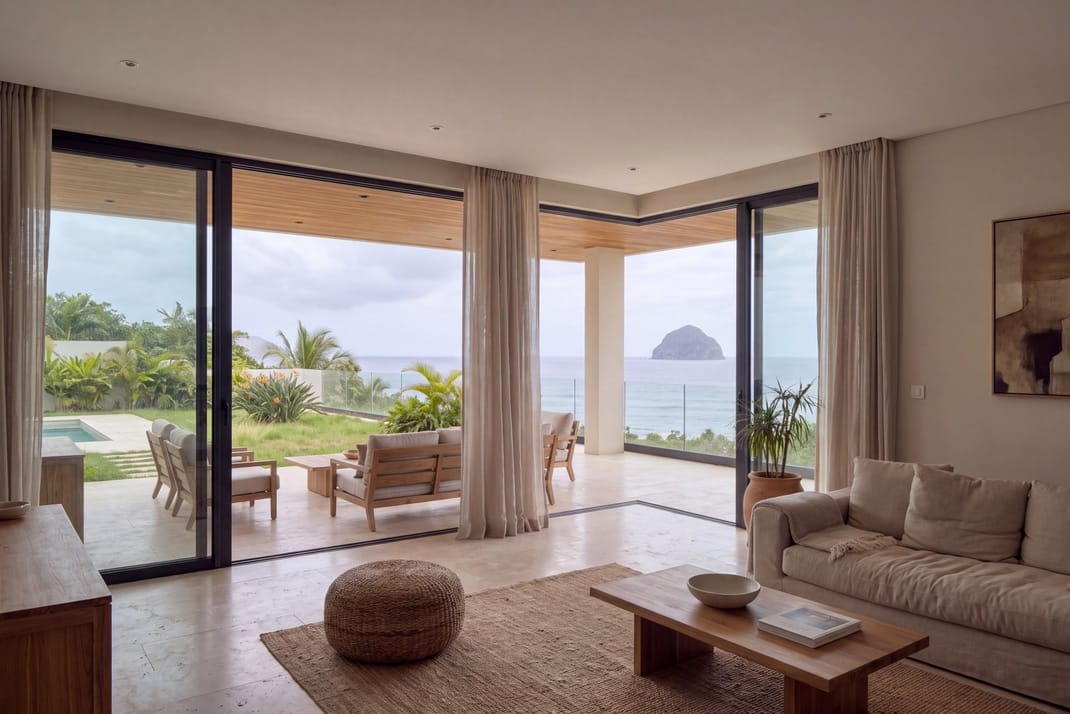
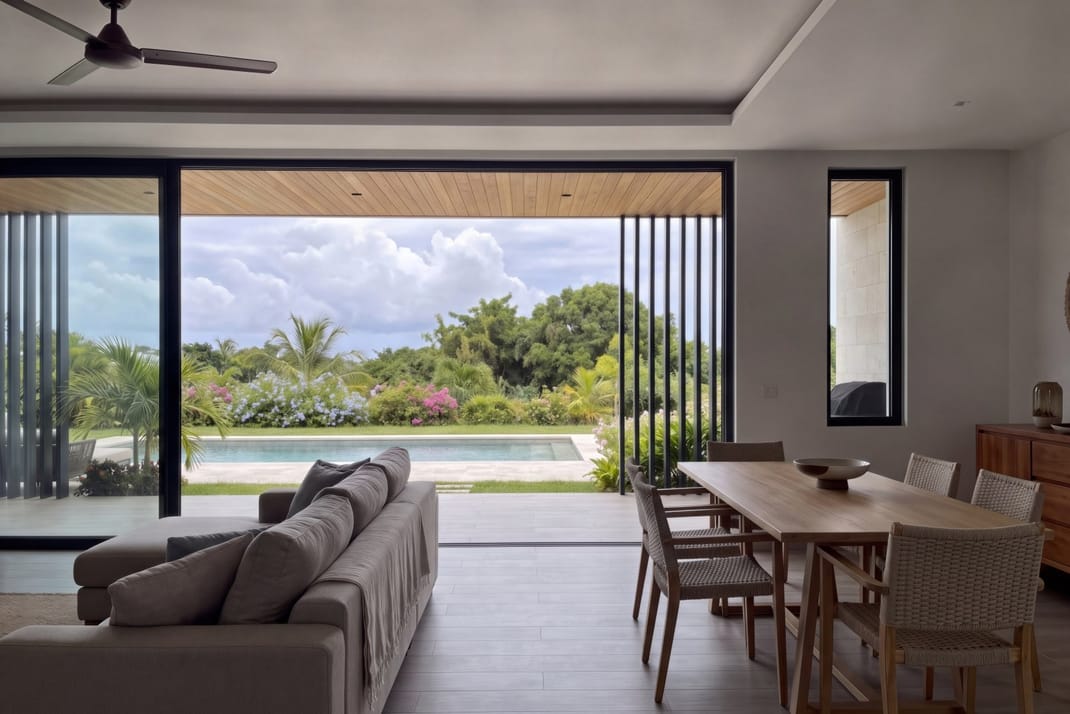
The first lever is siting: orienting the villa and its rooms to face the wind. The trade winds blow mostly from the east to northeast. Air speed is a key factor in comfort, because moving air lowers the perceived temperature. Each main room therefore benefits from opening onto two facades with different orientations, one windward, the other leeward. Inside, doors and passageways must let the air flow through.
Martinique’s thermal regulation (RTM) builds on this principle. For non-air-conditioned rooms in a dwelling, it requires openings on the windward facade or on two facades with different orientations, unless calculations show sufficient comfort. Its reference building has 20% openings on the windward and leeward facades.
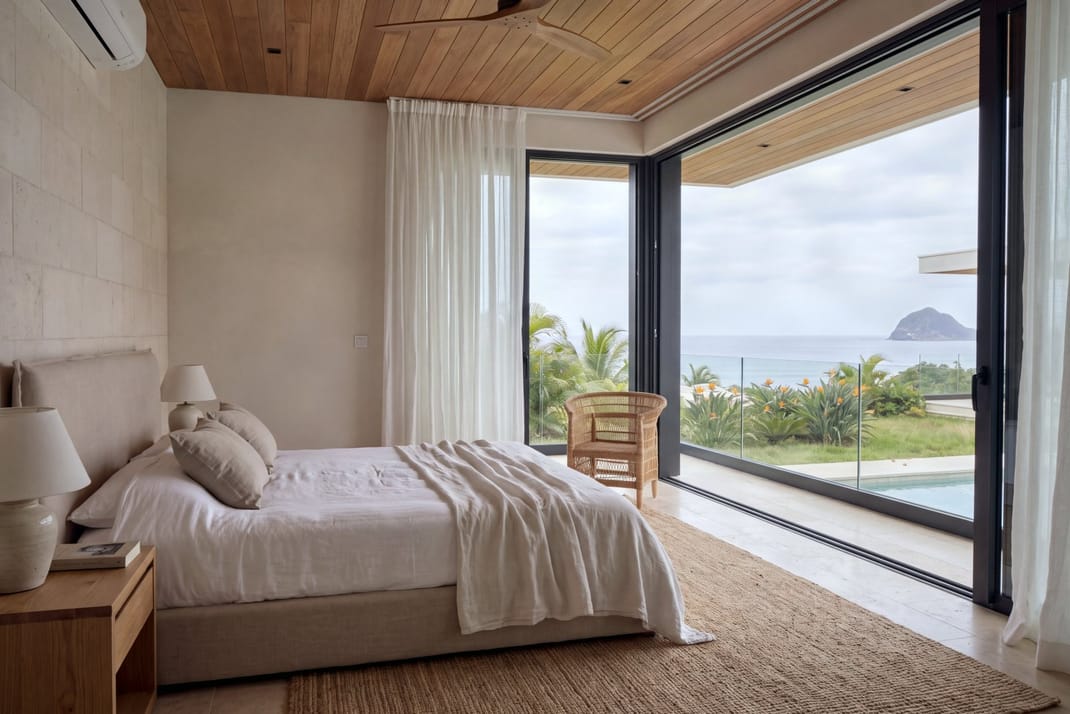
The ceiling fan (brasseur d’air) takes over when the wind drops, at night or during the hivernage. It uses far less power than an air conditioner. For the bedrooms of certain dwellings, the RTM in fact lists pre-wired ceiling fan points among the possible solutions.
Architect’s viewArchitect’s view
Roof, overhangs and brise-soleil: controlling the sun
At just under 15° north latitude, the midday sun stays high all year round: the roof is the surface that receives the most energy. Insulation, a ventilated air gap beneath the roof covering and a light color limit the heat transmitted to the rooms. The share of solar energy that a wall or roof lets through, its solar factor, depends on its composition, its color and its shading.
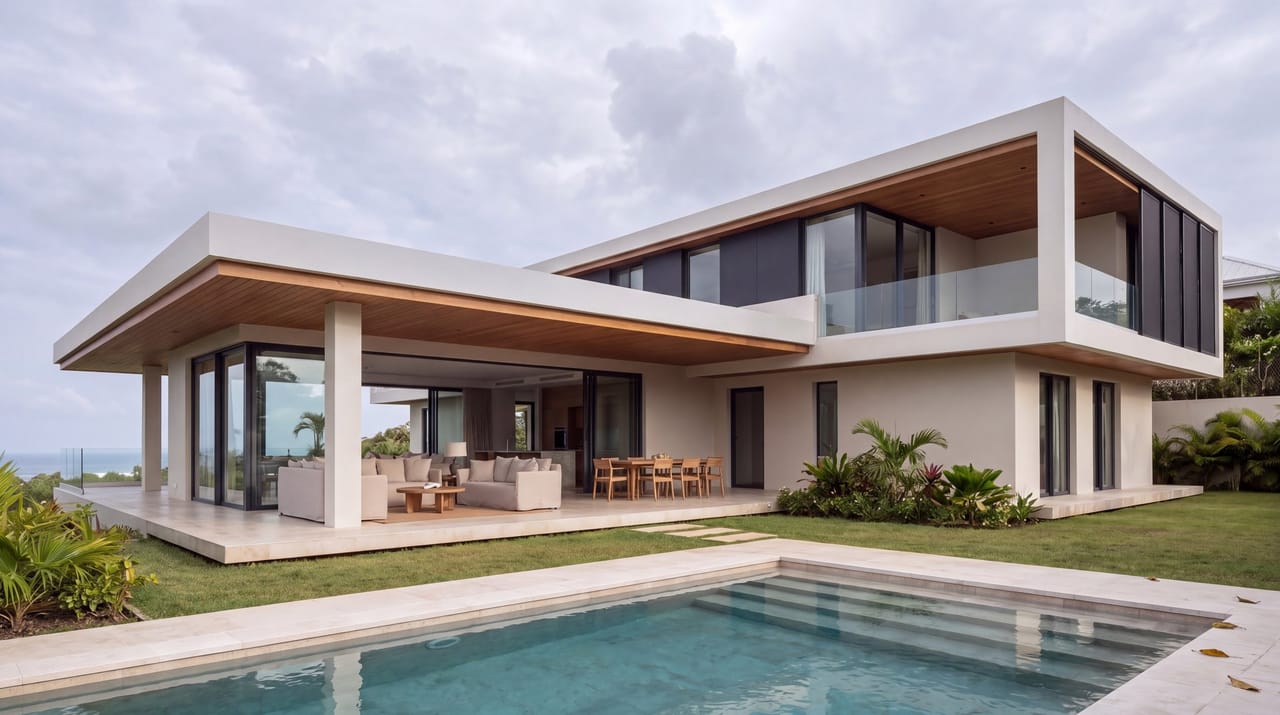
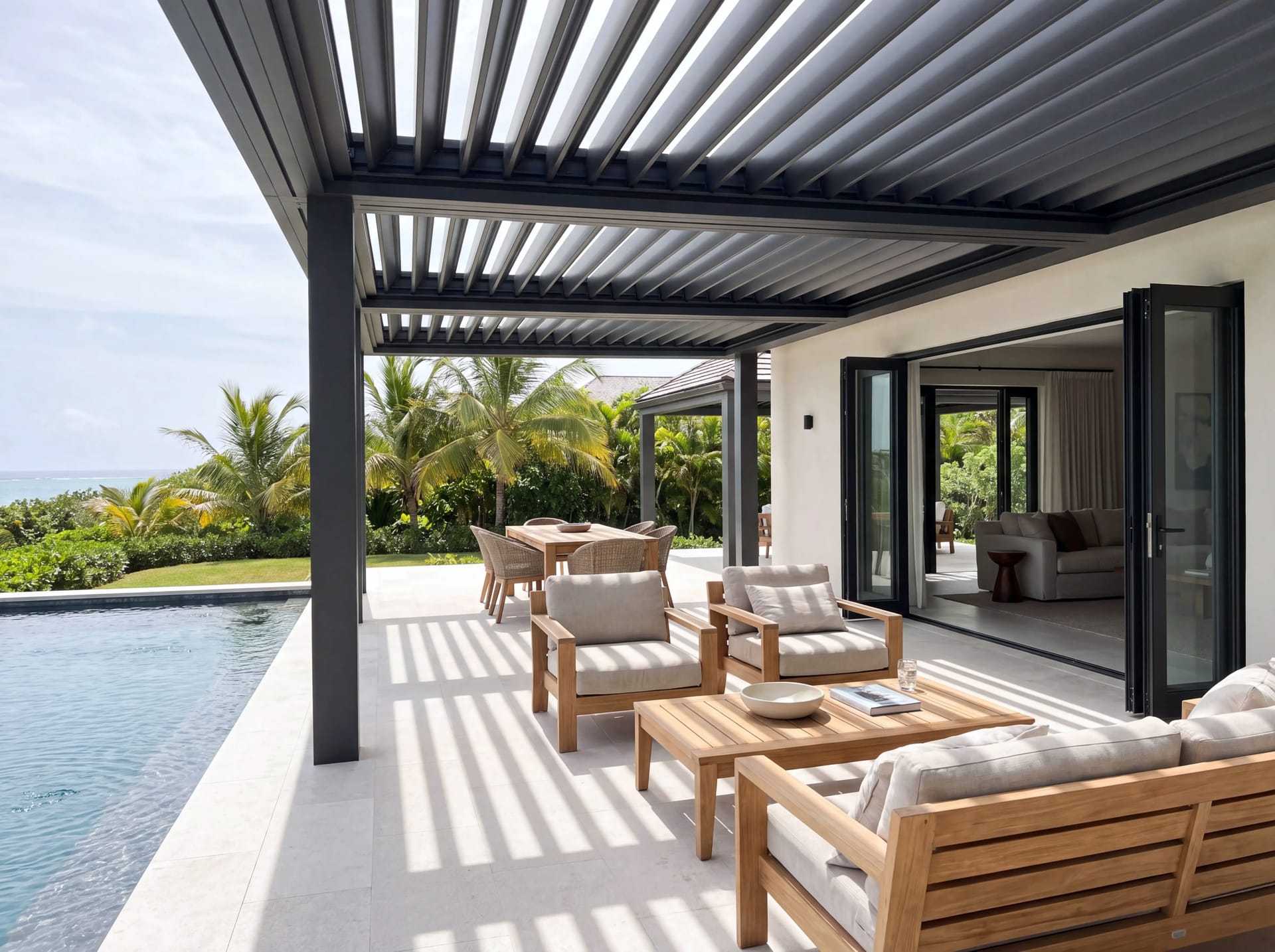
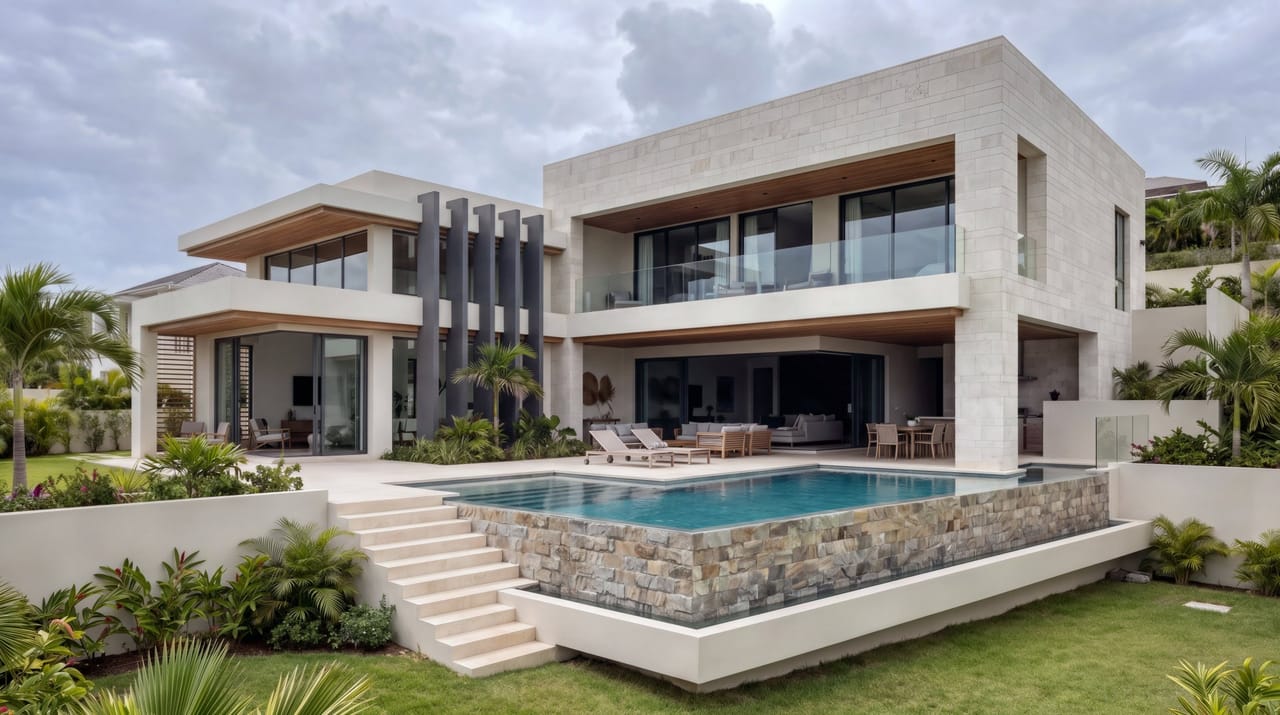
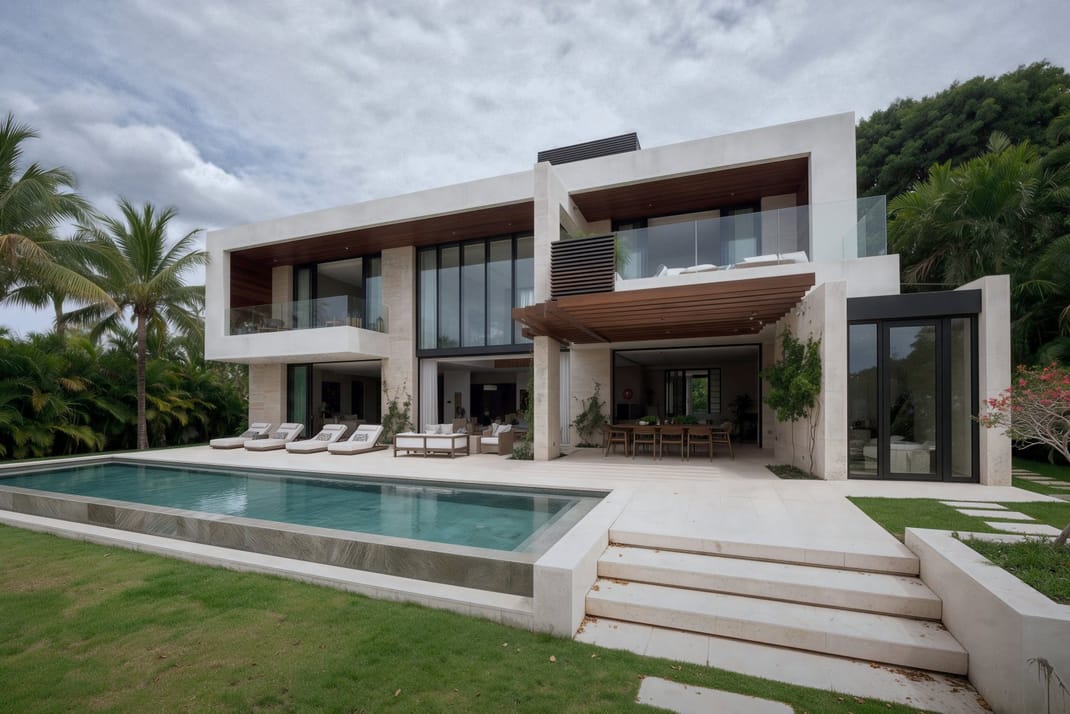
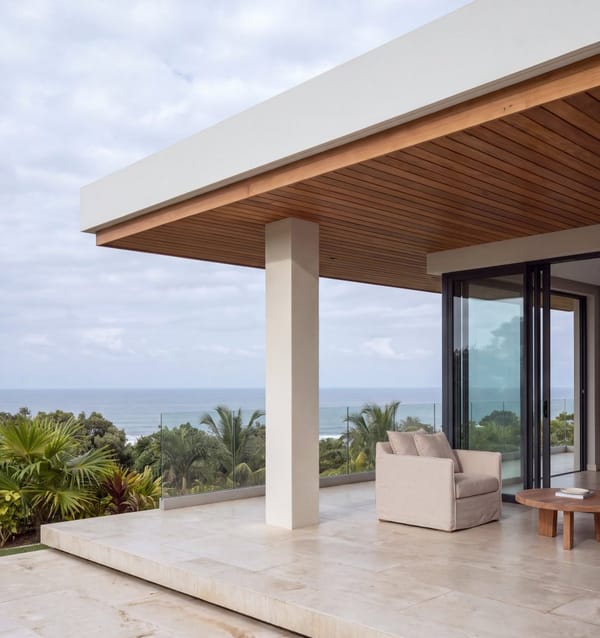
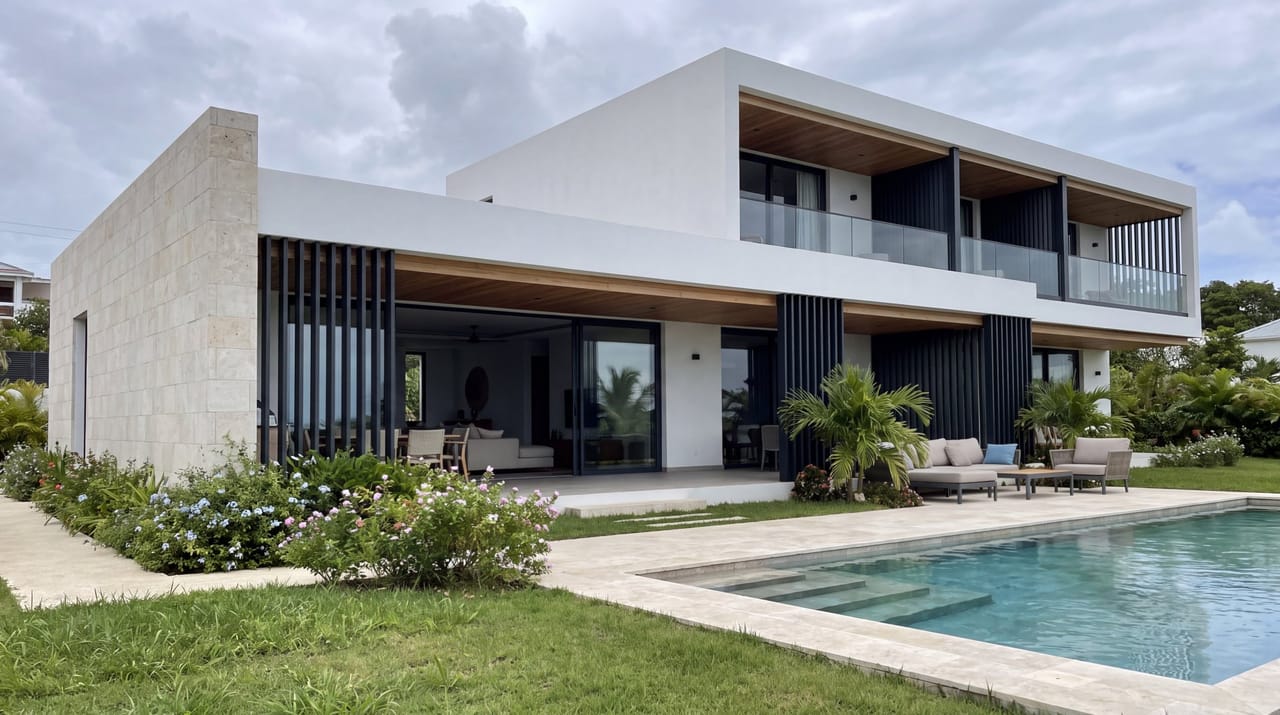
The east and west facades receive low sun in the morning and afternoon, which an awning blocks poorly: vertical brise-soleil, openwork screens (claustras), louvered shutters and vegetation work better there. On the south side, and on the north side in midyear when the midday sun passes to the north, horizontal overhangs provide good protection. Generous overhangs also shelter the facades from tropical rain.
Overhangs, awnings and brise-soleil also catch the wind: since January 1, 2026, the hurricane-resistant building rules require them to be designed to withstand hurricane winds.
Thermal inertia and materials for the humid tropical climate
Thermal inertia, that is, the ability of a heavy wall to store heat, must be handled with care in the tropics. A concrete wall exposed to the sun releases its heat in the evening, just when you want to sleep in the cool. Shaded from the sun and swept by the breeze, on the other hand, it helps even out temperatures. The impact assessment for the 2026 enabling bill also notes that the RTM places more emphasis on calculated performance than on bioclimatic design and the thermal inertia of materials.
Salt and humidity guide the choice of materials. The ministry’s guidance sheets consider a structure to be on the seafront as soon as it is exposed to sea spray, generally up to 800 m from the shore.
Windows and doors: aluminum and wood are preferred for their resistance in marine and tropical environments; laminated glass withstands impacts better.
Roofing and fasteners: aluminum or stainless steel near the sea; A4 stainless steel fasteners on the seafront, A2 elsewhere.
Metals: avoid direct contact between incompatible metals, such as aluminum and copper.
Wood: all of Martinique has been declared a termite zone by a prefectoral order of April 26, 2001, and new buildings must be protected against termites. Choose wood that is durable or treated for its intended use.
Concrete: sufficient concrete cover over the reinforcement, generally 3.5 to 4.5 cm, protects it from corrosion.
Architect’s view
Thermal regulations in Martinique: RTM, RTAA DOM and RE2020
No need to look for RE2020: it targets buildings in mainland France, and the French Construction Code (Code de la construction) expressly excludes it in Guadeloupe, French Guiana, Martinique, Réunion and Mayotte. In overseas France, the national reference is the RTAA DOM (thermal, acoustic and ventilation regulations), established by a decree and three orders of April 17, 2009, the latter revised in 2016. Its principles are set out in Articles R. 192-1 to R. 192-4 of the Construction Code, rewritten by a decree of March 1, 2024, and in force in that version since January 1, 2025. According to the ministry, its thermal order now applies only in French Guiana and Réunion.
In Martinique, thermal rules come under the RTM, adopted by the regional council (conseil régional) on June 28, 2013, and in force since September 1, 2013. For a dwelling, it compares two calculated indicators with reference values: the bioclimatic need (Bbio) and the thermal comfort index (ICT), which measures the share of occupied hours that are uncomfortable. The requirements of the 2009 national order remain accepted as a technical solution for purely residential buildings.
Field
Reference text
What it governs in Martinique
Thermal
RTM (resolution of June 28, 2013)
Thermal comfort, bioclimatic needs, natural ventilation, airtightness of air-conditioned rooms
Acoustics and ventilation
RTAA DOM (orders of April 17, 2009, as amended)
Indoor and outdoor noise, air exchange
Domestic hot water
Construction Code (Code de la construction), Article R. 192-2
At least 50% of needs met by a renewable heat source
Energy and environmental performance
RE2020
Does not apply in overseas France
This framework is set to change. The RTM has not been updated since 2013, and the French government’s impact assessment notes a gap between regulatory compliance and actual comfort, particularly at night; this gap leads to heavy reliance on air conditioning. Law No. 2026-574 of June 30, 2026, empowers the Assembly of Martinique (Assemblée de Martinique) to set its own rules on energy, including thermal regulations for buildings. So check the rules in force on the date your permit application is filed.
Architect’s viewArchitect’s view
Judicious air conditioning, solar hot water and photovoltaics
Martinique is a non-interconnected zone (zone non interconnectée): its power grid is not connected to the mainland. According to figures cited by the French Sénat, 73% of its electricity is still generated from carbon-based sources; air conditioning is the largest contributor to peak demand there. Thanks to tariff equalization (péréquation tarifaire), however, consumers pay for their electricity at the same rate as in mainland France.
Using air conditioning sensibly starts with not needing it everywhere:
reserve air conditioning for the bedrooms, and make the living areas ventilated, shaded spaces;
close off air-conditioned rooms: the RTM requires their doors and windows to meet at least air permeability class 1 (standard NF EN 12207);
keep the air healthy: the ventilation regulations require air inlets in air-conditioned main rooms;
choose high-efficiency units and protect the outdoor units from salt and sun.
For hot water, the Construction Code requires a water heating system in every new dwelling. At least 50% of hot water needs must come from renewable heat sources, unless the plot does not offer sufficient potential (Article R. 192-2). A solar water heater meets this requirement. Photovoltaic panels generate power during the hours of sunshine, which are also the hottest. Like the water heater, they must be fastened to resist being torn off by hurricane winds.
Architect’s view
Rainwater and vegetation, allies of comfort
Collecting rainwater helps get through the carême, the dry season. Since September 1, 2024, an order of July 12, 2024, has governed its domestic uses. Water collected from a non-accessible roof may supply toilets, floor washing, watering and outdoor cleaning; laundry requires a declaration. It remains prohibited for drinking, food preparation and personal hygiene. The main technical rules:
a network entirely separate from the drinking water supply, with the words “eau non potable” (non-potable water) at the draw-off points;
filtration of 1 mm or finer before storage;
opaque, covered tanks, and vents protected by an insect screen.
Vegetation complements solar shading. In Martinique, ADEME, the French agency for ecological transition, recommends greening the surroundings and roofs to limit heat gain. Planted ground heats up less than a paved terrace exposed to the sun, and a well-placed tree shades a west facade.
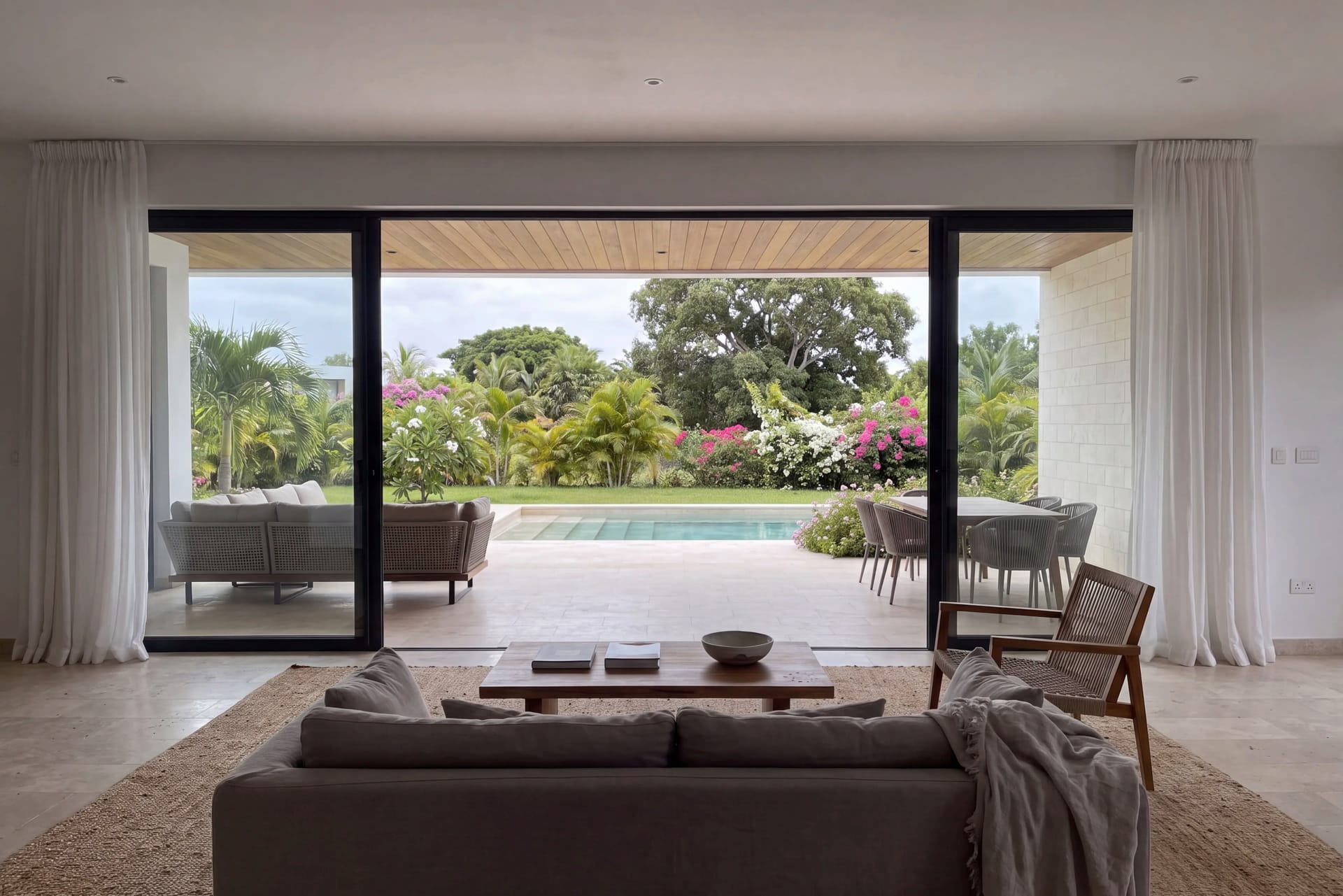
For a rental villa, these principles have concrete effects. Guests have living areas that open onto shaded, ventilated terraces, pleasant during the hot hours of the day. Bedrooms stay comfortable at night with ceiling fans and supplementary air conditioning. For the owner, fewer hours of air conditioning mean a lighter bill and less wear on equipment exposed to salt.
The villa still needs upkeep: rinsing windows and doors, checking fasteners, cleaning filters and solar collectors. Our guide to vacation rentals in Martinique details the rules for this activity, and our maintenance service handles this follow-up on site.
VillaDesign Caraïbes designs villas according to the principles of bioclimatic architecture, builds them, equips them, solar power included, then puts them on the rental market, with a single point of contact. To review your project, contact us or find out how to invest in Martinique.
This guide provides general guidance, checked as of the update date. It does not replace the advice of a notary, a lawyer or a tax advisor on your situation.
FAQ
Frequently asked questions
Short answers to the questions we are asked most often on this topic.
Does RE2020 apply to a villa in Martinique?
No. RE2020 targets buildings in mainland France, and the French Construction Code expressly excludes it in Guadeloupe, French Guiana, Martinique, Réunion and Mayotte. In Martinique, thermal rules come under the RTM, in force since 2013, supplemented by the acoustic and ventilation rules of the RTAA DOM.
Can a bioclimatic villa do without air conditioning?
Its main aim is to limit air conditioning use: orientation, cross-ventilation, solar shading and ceiling fans tackle heat at the source. Supplementary air conditioning remains useful in the bedrooms, especially during the hivernage, the hotter and more humid season. The French Construction Code also requires new homes to be designed to limit reliance on air conditioning.
Is a solar water heater mandatory?
The French Construction Code requires that at least 50% of a new dwelling’s hot water needs come from renewable heat sources (Article R. 192-2). A solar water heater can meet this requirement. The requirement does not apply if the plot does not offer sufficient potential for renewable heat production.
Where should openings be placed to make the most of the trade winds?
The trade winds blow mainly from the east to northeast. Preferably, open each main room onto two facades with different orientations, one windward and the other leeward, then let the air circulate inside. Terrain, vegetation and neighboring buildings alter the wind: a site study fine-tunes the villa’s siting.
Can rainwater be used inside the house?
Yes, for certain uses. Since September 1, 2024, rainwater from a non-accessible roof may supply toilets, floor washing, watering and outdoor cleaning; laundry requires a declaration. It is prohibited for drinking, cooking and personal hygiene, and its network must remain separate from the drinking water supply.
Will the thermal regulations change in Martinique?
Change is under way. The law of June 30, 2026, empowers the Assembly of Martinique (Assemblée de Martinique) to set its own energy rules, including thermal regulations for buildings, in order to modernize the RTM, unchanged since 2013. Check the rules applicable on the date your permit application is filed.